
Toxic Masculinity
Is it really a thing?

First, my apologies. I owe everyone some essays. I’ve had a dozen thoughts for this column and half as many partially-written pieces. But bupkes! Pretty much, the dog ate my homework. So I am starting again with what seemed to me—at first blush—like a quickie—two days and send it out. But the more I thought about it, the longer it has taken me to write it. Nothing is ever straightforward.
As we witness, in this moment, a form of masculinity that is so toxic that it has put us on the verge of a third world war, an analysis of toxic masculinity seems more than a little apt. So first the basic question: what is it? Is it a social structure? An individual personality trait? Are there many types of masculinity? If so who has what form and why? First, a personal disclaimer. There are many men in my life; they are interesting, warm, funny, kind, and, well, definitely not toxic. I love them and support them in their diverse versions of masculinity, and I have channeled one or another of them non-stop as I worked on this essay.
So if not the men I love, then who? During the 1980s the concept of toxic masculinity developed within a loosely organized men’s movement devoted to assessing the effects of gender/sex roles on men’s psychological development. Movement members posited that when an individual equated his masculinity with emotional suppression, aggression to the point of violence, and a profound fear of femininity in men, the results could be ugly.1 I still shudder as I remember a December afternoon in 1989 when an armed intruder burst into a mechanical engineering class at the École Polytechnique in Quebec, Canada. He told the men to leave, said that he was “fighting feminism”, and then shot the remaining nine women. He continued shooting as he moved through the school, targeting women and then shooting himself. Fourteen women, mostly science students in their early 20s, died.2 It was frightening. I had become known for advocating for women in science and I could not understand why pushing to make science more diverse evoked such violence.
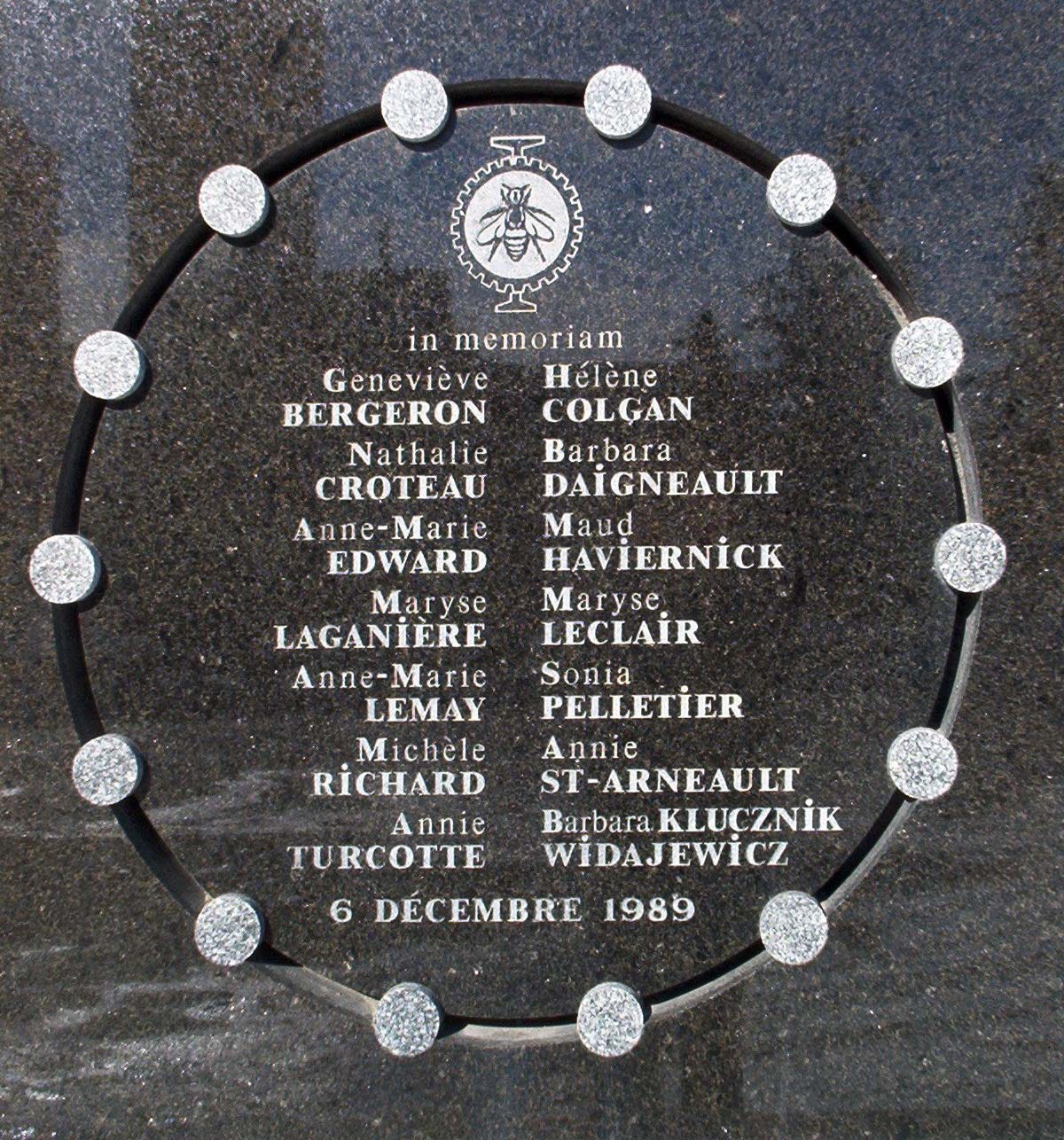
Pretty disturbing, right? But men in general can’t be held responsible for a one-off shooting or the more common wife beatings. (I was also on the board of a Rhode Island shelter3 for victims of domestic assault—the location of which was secret to protect the women and children within—so this too was on my mind.) Were these examples of a real syndrome—toxic masculinity—or was the phrase just a catchy meme? I thought I knew it when I saw it, but hardly anyone has seriously investigated toxic masculinity as an individual personality trait. So I was fascinated, now, over thirty years later to read the results of a study appearing in The Psychology of Men and Masculinities (published under the auspices of the American Psychological Association). The article title: “Are Men Toxic? A Person-Centered Investigation Into the Prevalence of Different Types of Masculinity in a Large Sample of New Zealand Men”. 4
Hoping to improve the tone and methods of past work, the study’s authors, led by the psychologist Deborah Hill Cone, analyzed data from a large New Zealand survey of Attitudes and Values, done from 2018-2019. They focused on results from 15,808 heterosexual men, ranging in age from 18 to 99 years, and from diverse ethnic (although 80% white) and economic backgrounds. After scouring previous studies for items that might be associated with toxicity, they chose 8 constructs to measure. I have organized these in Table 1.
Table 1: Constructs used to investigate patterns of masculinity
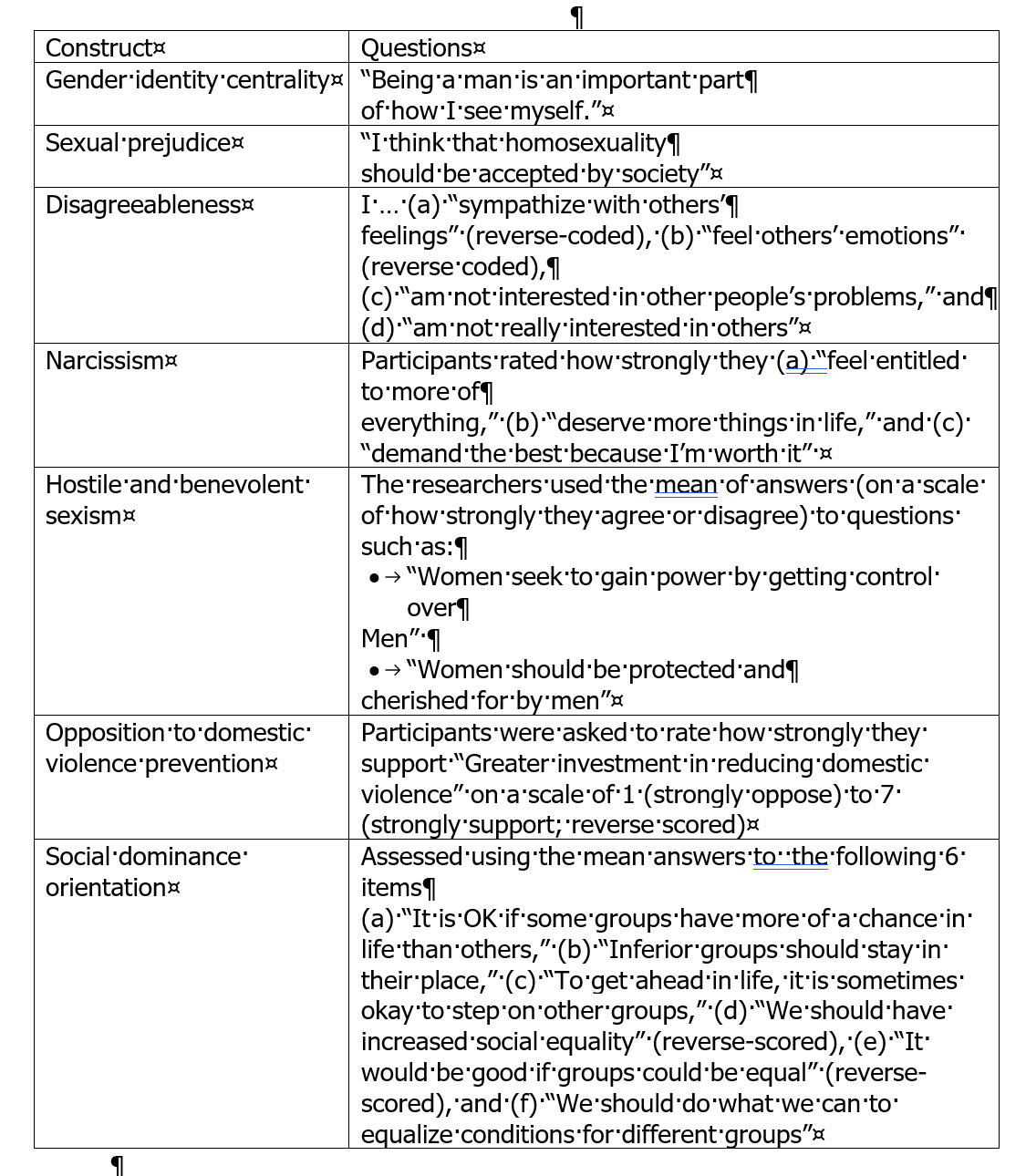
In the end they had over 15,000 answers to these 8 fairly complex constructs. To make sense of this mass of numbers, the researchers used a type of analysis called latent profile analysis. They wanted to extract groups with common response patterns from the answers to the 8 constructs, and they managed to distill out five profiles which they labeled —hostile toxic, benevolent toxic, anti-LGBT moderate, LGBT-tolerant, and atoxic. (I would love to hear from statisticians about how solid their statistical methods were, as I am unfamiliar with latent profile analysis).
I reproduce their graphic summary here, and pull out a few highlights. First, more than 60% of the men had an atoxic or LGBT tolerant Moderate profile. All of the men had fairly similar scores on gender identity centrality, and the tolerant and atoxic groups were also low in sexual prejudice, narcissism,and domestic violence prevention. Two profiles, summing up 11.5% of the men were labeled toxic (hostile or benevolent). Both scored high in sexual prejudice, while the hostile group also scored high on hostile sexism, opposition to domestic violence prevention, and social dominance orientation.
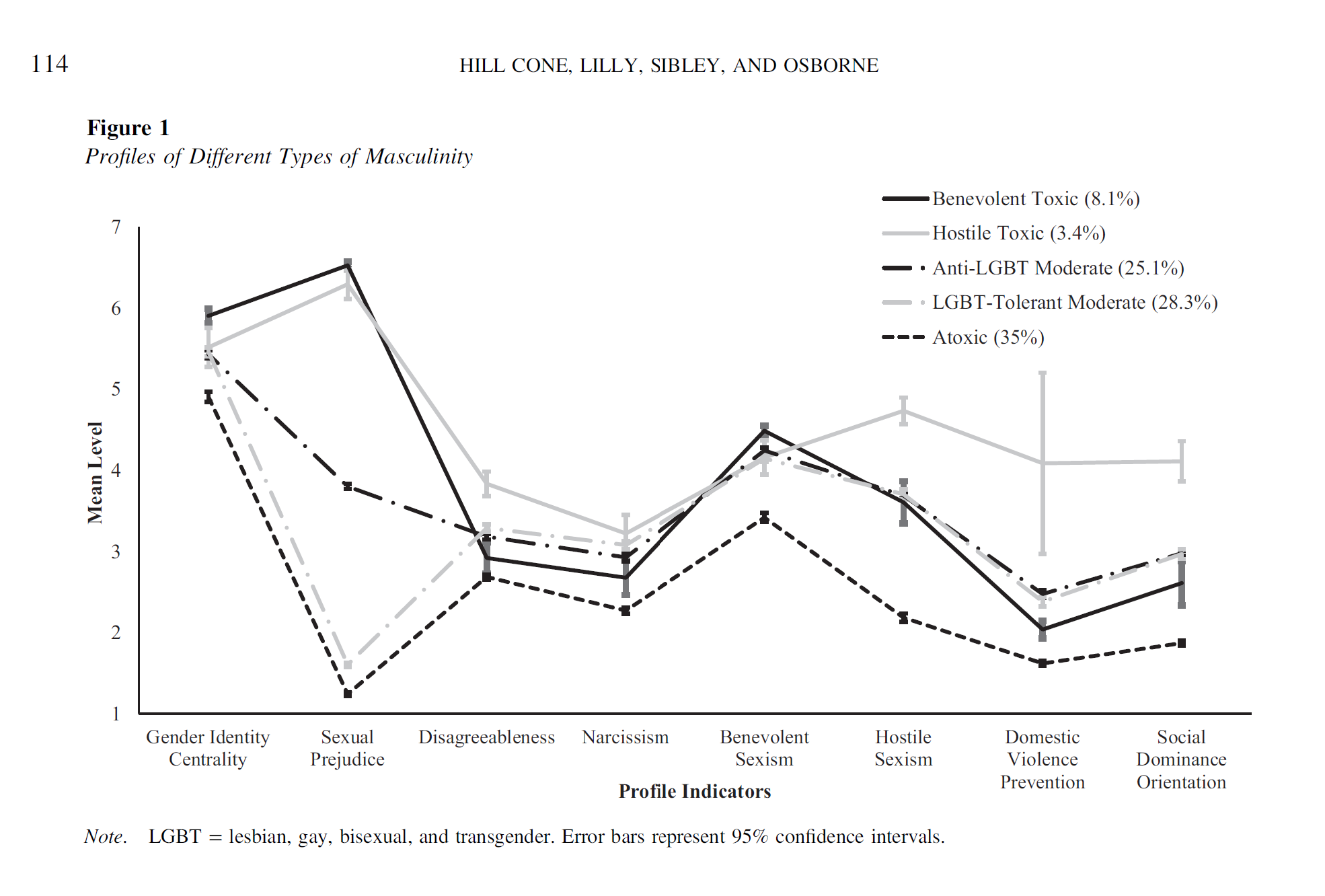
The psychologists and sociologists who authored this study also found that atoxic men were more likely to be employed, be in a relationship, and have had more education than hostilely toxic ones. Hostile toxicity was greater for those who were religious.
The scientists concluded: “the odds of belonging in the Hostile Toxic profile relative to the other profiles tended to be higher for men who were older, unemployed, single, religious, and an ethnic minority, as well as those high on conservatism, deprivation, and emotional dysregulation. In contrast, both education and body satisfaction decreased the odds of belonging in the Hostile Toxic (vs. Atoxic) profile.”
Deborah Hill Cone and her colleages agreed “that most men are not “toxic””, but there was that ~11% of the sample who had profiles they thought of as worrisome. While highlighting “the diversity of masculine identities,” they also believed that their study offered a baseline “ for developing a comprehensive understanding of how toxic indicators may (or may not) be related to masculinity.”
Interesting. But the article left me a bit mystified. The title “Are men toxic?” was equal parts catchy and misleading. The article didn’t really address whether men are toxic. Instead (and I’m not knocking this) it identified patterns of beliefs and personality traits within a large population of men. Their finding, that there is more than one way to be masculine seems unsurprising. To what extent, though, are these masculinity patterns associated with specific behaviors—the ones that lead to murdering female science students or brutalizing domestic partners or children? Are the men they have identified as Hostile Toxic more prone to violent behavior, especially directed at women, than the benevolent Toxic or anti LGBT moderate groups? And I can’t help but wonder where the Epstein class of super-rich, privileged, elite men would fit in the identified profiles. The authors suggest these men may be anomalous and that most toxic attitudes lie with underprivileged men . Here’s how they put it:
“Thus, high-status men who espouse toxic views, such as misogynist influencer Andrew Tate, are not representative of most men with toxic views. These findings also corroborate the broader body of crosscultural work showing that toxic attitudes tend to emerge among the least advantaged groups and are consistent with the resurgence of support for U.S. President Donald Trump among working-class ethnic minority men . Future work is required to investigate whether high-status individuals are capitalizing on (or fomenting) toxicity among these—and other—deprived populations.”
Something is missing in this analysis. They really trust their data, which is a good thing, I guess. But they aren’t worried enough, IMHO, about anti-working class bias or stereotypes. Calling the ribbed cotton tank tops that my father used to wear “wife-beaters” comes to mind as an influential classist meme about men who buy 10 packs of cotton undershirts. Or maybe they needed a different construct to capture how power and wealth can promote toxicity.

Is toxic masculinity a real thing? Confronted with men, such as our current Secretary of Defense, who play act a definition of being “a real man” that combines hyperaggression with profound sexism, racism, and homo and trans phobia, and videos of blowing stuff up, the answer is yes. But doesn’t this person embody an ideology rather than a personality trait?
Is toxic masculinity a useful construct for understanding why some men behave violently toward women? In recent years feminist scientists have called on researchers to stop using the words sex and gender as stand-ins for undefined underlying features. Consider the often published statistics that women have higher rates of immune disease than men. Most often that’s as far as it goes. Scientists simply state that this is a known sex difference with the unspoken causal assumption being that men and women differ biologically. But feminist scientists have pointed out that there are other possible routes to such a difference. Are boys and girls, and later men and women, differently exposed to dirt and microbes, because of their different gender roles? Might this affect their microbiome? Further, might different exposures relate to gendered norms of play for children?5 Wouldn’t our understanding of violent men be aided by analogous reasoning, by looking beneath a glib label at factors that lead to violence and hostility?
Recently two feminist bio-scientists noted that the idea of sex as an important participant in studies of human development and behavior is used in several different ways.6 Most often scientists use sex categories to divide study subjects into two buckets—male or female. By analogy this seems to be the gist of this study on masculinity—creating categories of masculinity. But sex, they wrote can also be understood as a dynamic system, with numerous interacting features promoting the emergence of a variety of attitudes and behaviors. Deborah Hill Cone and her colleagues identified certain important components or correlates of the categories they teased out of their data; they have given us likely components of masculinity as a dynamic system. Next, we need to learn more about how the properties of masculinity, the nurturing, the caring, the achieving and creative, and, sadly, yes, the hostile and violent emerge from this developmental dynamism. Toxic masculinity is not—analytically speaking—a helpful concept. Masculinity as a dynamic system is.
See for this and other examples: Ritz, S. A. and L. Greaves (2022). “Transcending the Male–Female Binary in Biomedical Research: Constellations, Heterogeneity, and Mechanism When Considering Sex and Gender.” International Journal of Environmental Research and Public Health 19(7): 4083.
Ritz, S. A. and L. Z. DuBois (2025). “Reframing the sex debate in scientific research: three frameworks to support rigor without rigidity.” Biol Sex Differ 16(1): 106.
Point taken. I am not well read enough to comment on John Stoltenberg or Andrea Dworkin. And because I think there can be a healthy masculinity and manhood, I might not align with the radical feminism out there. My own rejection of manhood is because I'm trans. But otherwise I am not at war with men automatically. I don't think all men are bad or that masculinity is something to be rejected no matter what (and dare I say that a trans woman can desire a cisgender man and a relationship arrangement that is looking a bit traditional even). The conservative men I am talking about are expressing a masculinity that clearly minimizes and limits women's options and possibilities in life. It really is anti woman, and this goes beyond just the trad wife thing. And I would argue it's not even a viable masculinity or roll for men to aspire to. But the fact that many of these men get away with it and it's part of established norms, means it is valid for many people. And frustrated young men are buying into it to whatever extent. And they're trying hard to hold on to a power structure and control that has been slipping away from them for decades. So these types are inherently toxic. If I call out the entire structure and arrangement in the United States for men and women, and marriage and the family as corrupt and toxic, then I'm instantly a radical Lefty and all of that.
But the example I gave is a mindset and a cultural framework more than a mere performance I think. See I'm not any kind of a feminist expert, so I get in the weeds real quick. But I know when something's not right. And I have my upbringing and decades of experience (yes much of it vicarious) as a backdrop and reference point to what needs fixing. There's an outright war on women under Trump and the Republicans. And that's been made clear at this point.
Very interesting and well stated. But as for the education level, what do you do with men in The Heritage Foundation for example? Who hold PhDs, but clearly regard women as subservient and ideally giving up their selfhood for married life. Take a look at this about
Scott Yenor:
https://substack.com/@cyndilavin/note/c-236528989?r=72g83a