
Human evolution
"a complex web of populations connected by repeated episodes of migration and mixing" (1)

I admit it. Biology is rarely simple, and I revel in complexity. So it is to my chagrin that people often invoke simplicity to shore up some argument or other about biology and social policy. The secretary of defense’s plan to measure testosterone levels in members of the military is a current example. Or, I am often told,—usually by someone on social media “explaining” sex to me —that defining sex is simple. People with sperm are men and those with eggs are women.1 Or, understanding race is simple.2 There are, so the simple story goes, 5 of them and they diverged during evolution so that each race has different phenotypes.3
I could take on each assertion of simplicity case by case. But pushing back against claim after claim that biology is a simple answer to some contentious problem makes me feel like the poor king in Royal Match, who hopes that by matching the right tiles the game player will prevent him from being impaled by an ever advancing wall of spikes . So I have decided to try a different tactic: over time, with intermittent short posts, I will describe some example of biological complexity. Some examples will be about sex, gender, secuality or race; others some feature of basic biology or evolution. As the examples accumulate maybe I can change thought habits so that for more and more people the go-to starting point will be: “biology is complicated and simple explanations are unlikely to be true”!
In this episode I report on recent findings about human evolution. Geneticists have been studying small regions of DNA found in individual human genomes (the totality of DNA in the cell nucleus of each individual). They playfully call these DNA segments “ghost DNA”, remnants (and reminders of) ancestral dalliances between modern humans and archaic human relatives or between different evolutionary lines of non-modern hominids.
In the beginning, as it were, scientists envisioned human evolution as a linear process. Ancestor A preceded ancestor B, then C. At some point Homo sapiens took charge, migrated out of Africa and spread around the world. As scientists found more and more protohuman fossils, it became clear that some were side branches and linearity gave way to bushiness. But still the idea was of forward progress. This diagram from the Museum of Natural History offers a visual.
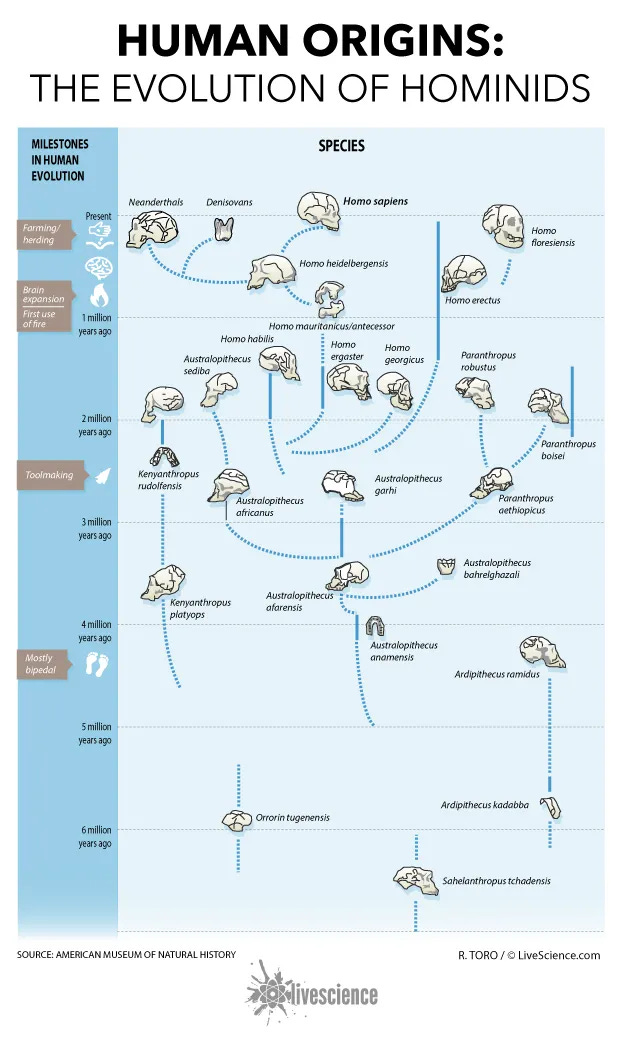
Notice especially the top tier—less than a million years ago. Homo sapiens, the Neanderthals and a group called the Denisovians are all around at about the same time, and are thought to have branched off from a common ancestor. (This will no doubt change with new findings of fossils and new methods of analysis, but it is what we know at the moment). Anyway these groups are illustrated as existing in pristine parallel.
But we have known for a while that modern humans mated with Neanderthals and with Denisovians, and now it appears there were other mystery ancestors—the ghost ancestors. And there was quite the back and forth, as shown in this diagram.4
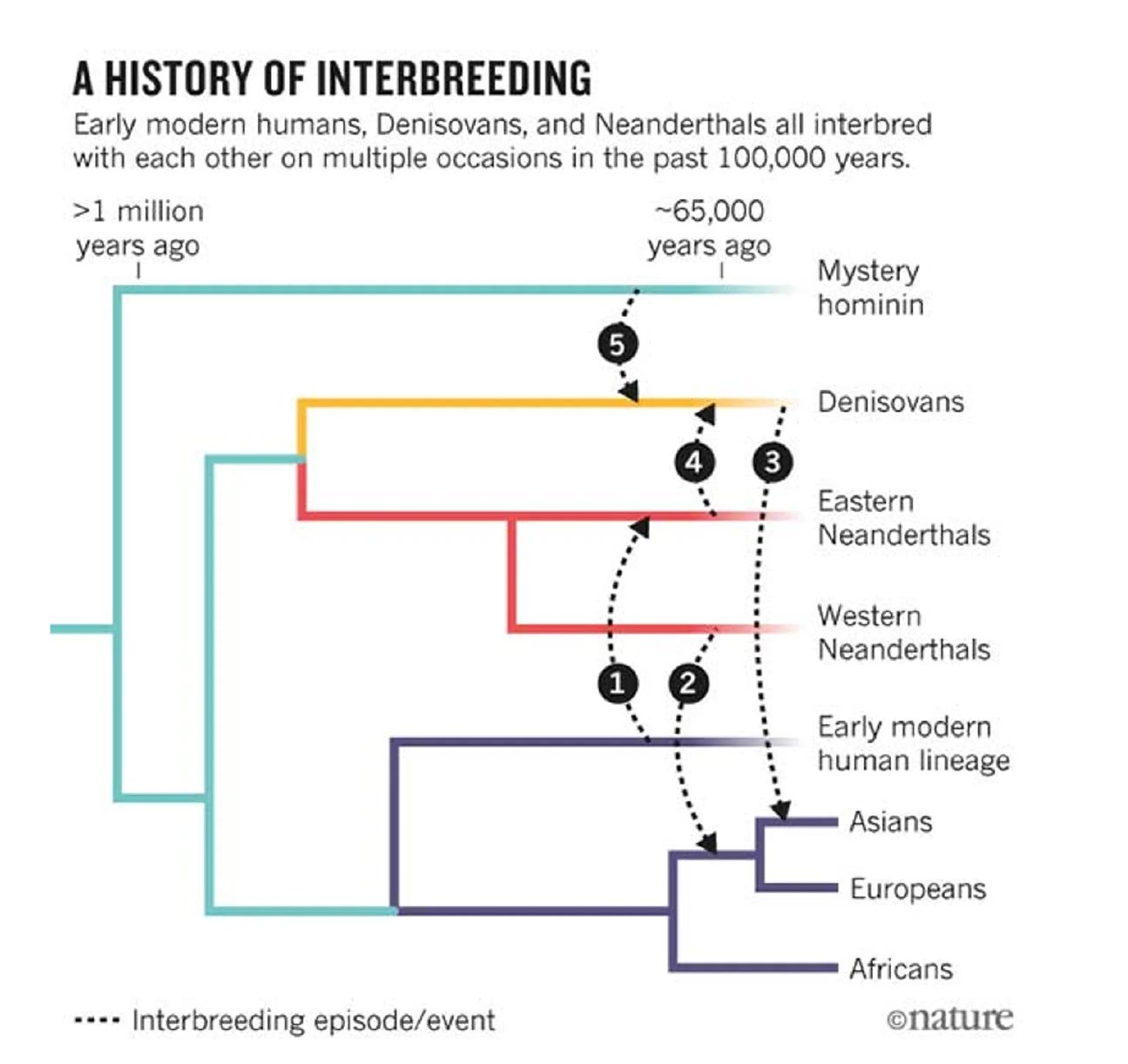
Source: https://www.nature.com/articles/nature.2016.19394
Findings since this 2016 diagram show an even more complex picture. Human and protohuman populations have mixed frequently and way farther back in ancient human history than had been imagined. As researcher Priya Moorjani said, “We often think of human evolution as a branching tree, but new genomic data and analytical methods reveal a much more interconnected history — more like a complex web of populations connected by repeated episodes of migration and mixing.” (1)
The above diagram, which dates from 2016 shows more recent (i.e. 60-100,000 years ago) intermixing between several lines of human ancestors. It is less a branching bush and more of a net or mesh.
Since 2016 researchers have traced the ghost mixing back even further—closer to a million than 100,000 years ago. More canoodling, earlier than previously realized, and with greater varieties of ancestors.
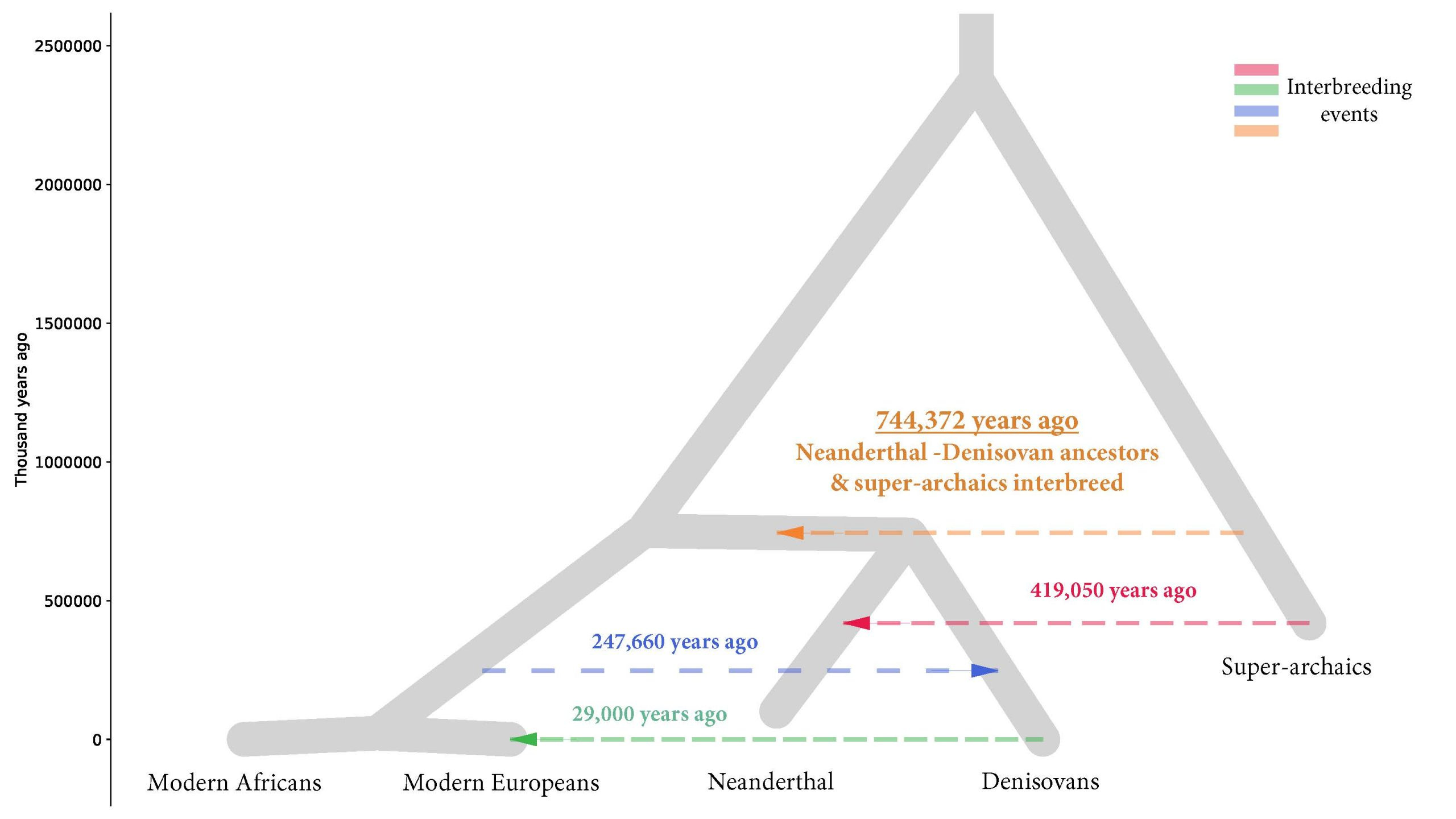
The above illustration depicts that despite an early branch in the human lineage that took place a bit over 700,000 years ago, individuals from separated branches interbred. Then again, half a million years ago they interbred again. Then a quarter of a million years ago, members of the main hominid line back bred with at least one of the more recent branches and a mere 29,000 that line bred again with modern Europeans. So far this is what we have evidence for. I have little doubt that those big time gaps will shrink and the number of data-backed inter-group mating events will increase. Intermixing, it seems has been going on for nearly a million years, a finding which make the idea of “racial purity” ludicrous. And they highlight human evolution as a premier example of evolutionary complexity.
See Julia Serano “Why are “Gender Critical” Activists so Fond of Gametes?” as well as her video JuliaSerano.substack.com February 2024. as well as her video “Trans People and Biological Sex: What the Science Says”
See some of my earlier substacks
Y. Zhang et al., Science 10.1126/science.aef8874 (2026)
(1) The quote in the subtitle is from Priya Moorjani Associate Professor if Molecular and Cell Biology, at UC Berkeley. Source: https://phys.org/news/2026-07-technique-human-dna-inherited-ghost.html
v. clear. v. important!