
A glass half full
Some thoughts for newly minted graduates (and all the rest of us)

Graduation hullabaloo has wound down. Graduates have left town—off for summer adventures, new jobs, resting at home with parents and siblings before they fly the coop for real. On July 4th I watched fireworks that celebrated the 250th anniversary of the United States. So now might be a good time to share some of the thoughts I had on offer at the Lavender Graduation organized by the Harvard College LGBTQI students this June.
A bit of background is in order, and of course it starts with Donald Trump and institutional cowardice. As soon as he took office, Trump froze millions of dollars in Federal grant money that Harvard faculty members had earned for peer reviewed research projects. Supposedly Harvard stood firm and the government backed down and reinstated the grants. But that was a cover story. Internally Harvard began a process that we can, with a straight face, call white-washing, and also gay and gender diversity cleansing and more.
On April 28, 2025 Harvard rebranded its “Office for Equity, Diversity, Inclusion, and Belonging” as the “Office for Community and Campus Life”. They also announced that the University would no longer host 10 so-called “affinity graduations”. Affinity graduations allow students with similar national, racial, gender or sexuality backgrounds to celebrate their accomplishments as a group. It is an add-on, not a replacement for the all-inclusive official, degree-granting ceremony. With so little notice a scramble ensued, but eight of the ten celebrations that Harvard had hosted on campus in 2024 managed to find off-campus venues and financial support for some festive decorations and a reception. The groups included Black, Latino, first-generation, low-income, LGBTQ+, Muslim, and Asian, Pacific Islander, and Desi American (South Asian-American) graduates, as well as veterans and people with disabilities. 1
This year, 2026, with more time to plan and fundraise, the same eight again held off campus affinity celebrations. I was honored when the student organizers of the LGBTQ+ group invited me to be one of two keynote speakers.
Here are my remarks.
I have to start by congratulating all the graduates. You have worked hard to get to this point, and what an achievement! You deserve joy, praise and camaraderie; I offer you all of this and hope that you will offer the same to one another. The parents and families of today’s graduates also deserve congratulations. For loving and encouraging your children, for making all the efforts and sometimes sacrifices—the ones that sometimes only you know about-- to help your child reach this goal.
As a teacher, I always found myself sad and exhausted by the end of graduation day. Just as you have worked hard for four years, we teachers do our best to contribute guidance, encouragement, knowledge, and the occasional nugget of wisdom to your journey, and finally, on graduation day, to wish you well, and push you over the threshold to the next phase of your lives. For you it is the start of a new phase of life. For us, a parting. So, I also want to congratulate all your teachers who have worked harder than you may realize to help you to this point. Each one of you is the result of a massive group project, people! And YAY for the entire collective.
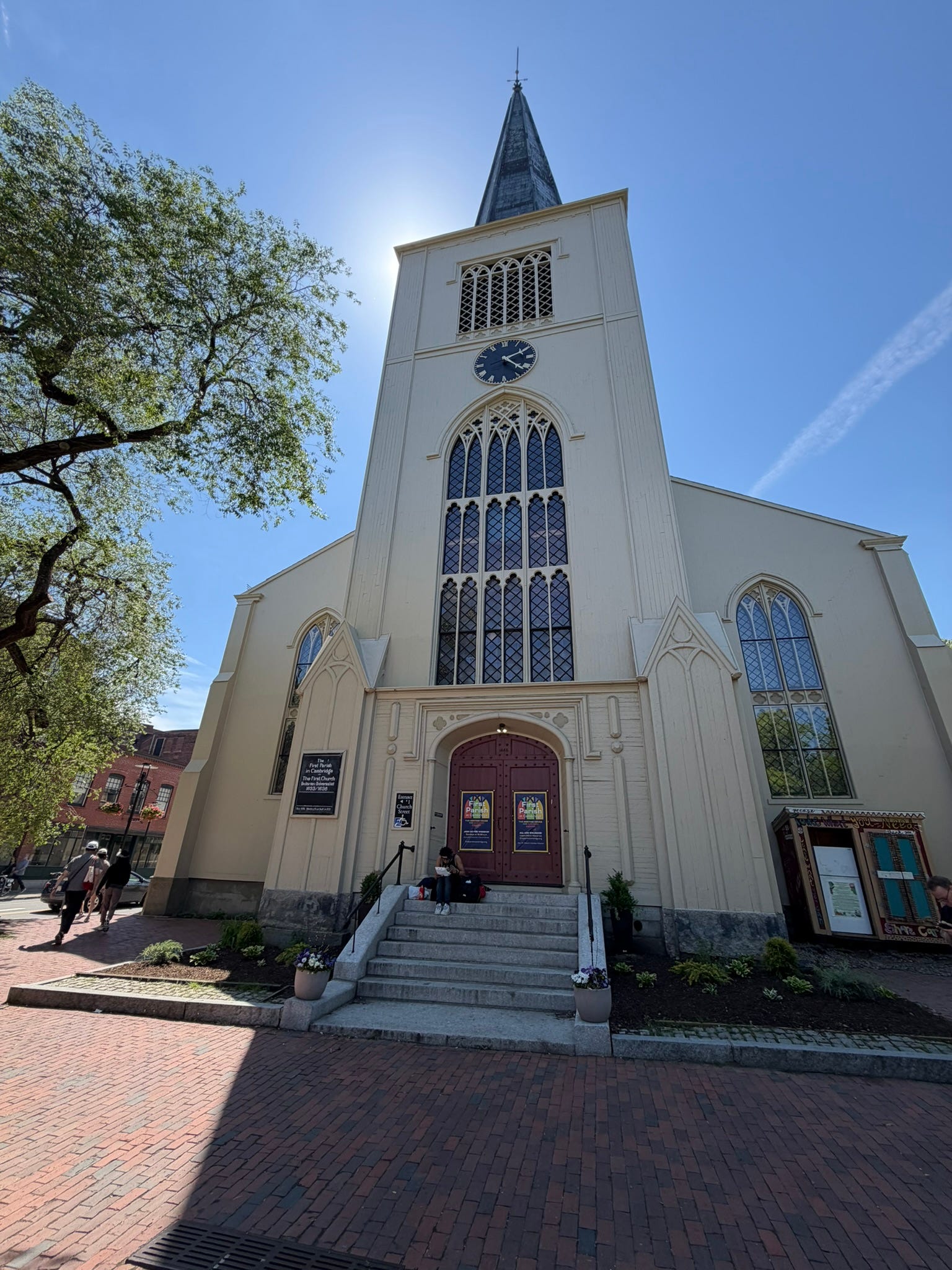
Now let’s turn to that giant elephant in the room. This is the second STUDENT LED Lavender Graduation (at least since the mid 1980s), and I am very proud to have been asked to speak at this historic event. The bad news is that in these difficult times, the institution of Harvard University has lost both its nerve and its moral center by backing away from official support for, and celebration of student diversity. The good news is that Harvard’s students have stepped into the breach. You have discovered the empowerment of working together, face to face [it really beats relying on social media] on a common goal. You have organized an event for yourselves, and discovered that there are non-Harvard institutions, such as this awesome and historic Church, that embrace you and offer you shelter. The world is much larger than Harvard.
Of course it is not just Harvard. The entire nation is having a moment. We are moving from a time that we had come to think of as normal, a time when institutions seemed to embrace diversity, equity and social justice, to the post normal, when it appears as if we are picking our way through ideological quicksand. Suddenly, but not suddenly, word meanings have taken on an Alice in Wonderland quality. The government defines those who support diversity as discriminating against straight people, or cis people, or white people, or—let’s just say it—against straight white men. Assuming that most, if not all of you at some time in your life read Lewis Carrol’s Through the Looking Glass, this craziness should be familiar. I often turn back to this conversation between Alice and Humpty-Dumpty:
“`I don’t know what you mean by “glory,”’ Alice said.
Humpty Dumpty smiled contemptuously. `Of course you don’t-- till I tell you. I meant “there’s a nice knock-down argument for you!”’
`But “glory” doesn’t mean “a nice knock-down argument,”’ Alice objected.
`When I use a word,’ Humpty Dumpty said in rather a scornful tone, `it means just what I choose it to mean--neither more nor less.’
`The question is,’ said Alice, whether you CAN make words mean so many different things.”
Inverting the meaning of words such as bias and discrimination is shocking, but as Humpty-Dumpty themselves pointed out we can assert control over the matter. If we have now entered into a post-normal era, I am old enough to have lived in the pre-normal, before there was any institutional support for studying gender/sex and sexuality, before there were programs to help gender non-conforming children to live their lives in the open, before it was normal to admit more than 10% women, 5% Jews or even fewer people of color to a new medical school class. Before Harvard had any women or people of color in the rank of full professor. There were no institutional structures to promote or protect us.
So we had to build our own. We followed an already-worn path. For every (all white) American Medical Association (founded 1847), for example, there was a National Medical Association for African American Physicians (Founded in 1895) dedicated to equitable medical treatment. In the 1890s American institutions such as Harvard, Johns Hopkins, and the Smithsonian supported tables for American (white, male) scientists’ to carry out research at the Naples Zoological Station. By the 1890s a group of women scientists had banded together and funded the Naples Table Association for Promoting Laboratory Research by Women, and sent numbers of women off to Naples to study marine biology alongside the men. The built their own institution to circumvent ones that rejected them.
Speeding into the late 1960s, when no official sources existed to teach women about their own genital anatomy—we (this was MY generation) got speculums and mirrors and looked for ourselves!! We wanted the truth about menstruation and other health related questions. And so a group calling themselves the Boston Women’s Health Collective got together and wrote a pamphlet called “Women and their Bodies”. I sold the New England Free Press newsprint first edition for $.75 on a Providence, Rhode Island street corner. A large carton sold out in less than an hour. Only later did Knopf, a mainstream publisher, pick it up under the name “Our Bodies, Ourselves” . This was happening during the same time period that the Black Panther Party founded and operated the People’s Free Medical Clinics, which offered first aid, childhood vaccinations and “screenings for high blood pressure, lead poisoning, tuberculosis, and diabetes.“
Meanwhile, back at Brown University group of about 5 assistant (untenured) professors, unsupported by any dean or department, designed and taught Brown’s first introductory women’s studies course, and the students came. One of us, Louise Lamphere, later sued Brown for tenure denial, a class action suit on behalf of all women, and ushered in the era you now know, in which there are many women faculty including, even full professors, and university presidents. The process at Harvard was a bit slower (not that I am competitive on behalf of my home institution-LOL) and was student-initiated. In 1978, responding to student petitions, Dean Henry Rosovsky established the Committee on Women’s Studies, which encouraged the development of departmental courses in the field, and in 2003 this committee became a degree-granting department –the Committee on Degrees in Studies of Women, Gender, and Sexuality (WGS).
And so, gradually, we entered an era of plenty; one in which it seemed to make sense to fund an entire school on soft money. One in which it was taken for granted that public health is a social good. One in which Universities officially celebrated diversity—with women’s centers, centers for African and African American Research, Queer Students Association, SHADE, Trans Harvard and more. The NIH funded medical research that focused specifically on minority lives and experiences. Affirmative care became the treatment norm, and young children could socially transition with the support of parents and schools.
But now we face intense pushback. I will put it up front that this change is painful and sometimes bewildering. But we have a history. WE—minority citizens and their majority allies-- built the era of plenty and acceptance that is now under attack. And we can reconstruct a new era, returning to our older practice of building our own structures and charting our own paths. The good news is that there are a lot of us (many more than in olden times!) and we are already organized.
For example, I follow a simple listserv, founded after the 2024 Presidential Election, that has become a hub for information exchange—about funding opportunities, jobs, how to write a grant that can slide through the AI screening process; this same listserv functions as an organizing center that can gather forces to prevent a takeover by anti-trans medical workers at a professional meeting, or recruit data scientists to a LGBTQ Data Rescue Hackathon; and more.
Despite the Quisling-like collaboration from official circles at Harvard, Columbia, Penn and elsewhere, not all structures are wrecked. Before the backlash took on full force, for example, a number of new scholarly journals came into being, each dedicated to improving knowledge about gender and sexuality. Professional societies focused on LGBTQI health and well being already exist. Far from building from scratch, I think we are in a stronger position than I at, least at first, had realized.
As shocking and painful as they are, the current assaults on our communities also present opportunities— to pursue our own interests, develop new theory, and ready a successor science of gender and sexuality to seize the next moment---the one that comes after the counter-revolution has been defeated or at least restrained. This is the opportunity that you, the graduating class can seize and run with. You can complete the disrupted databases, further develop the ideas, the methods, the clinics and social services which we have already begun, and which we never stopped working on. You can use your capacious imaginations and your fresh perspectives and abundant energy to imagine new ways of moving forward, maybe even ways that are a bit more armored against the kind of backlash we are currently experiencing.
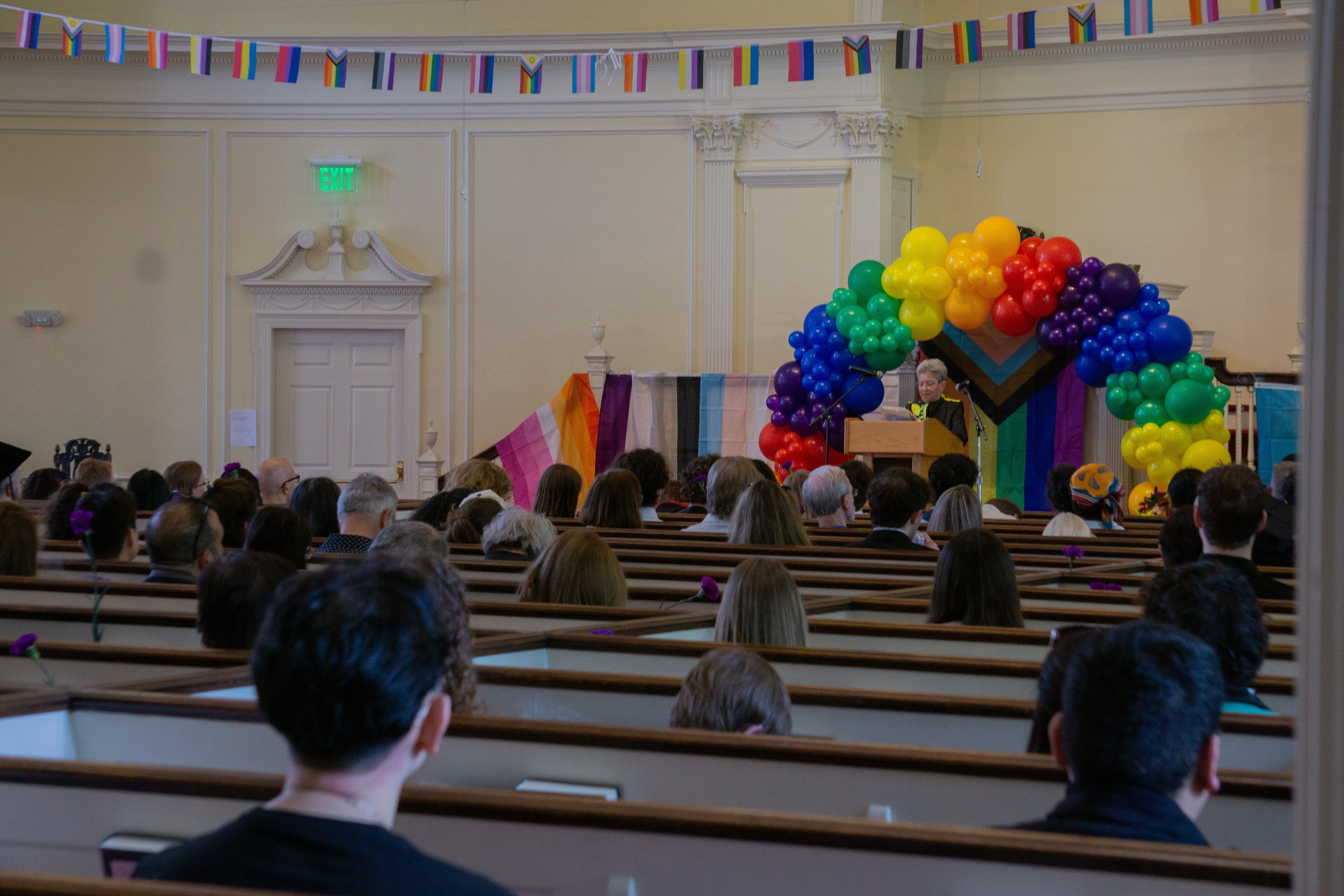
This may be a bit obscure, but I started my science career studying insect development. Insect eggs hatch into larvae, which eat, grow and shed their skin to become larger larvae. Eventually the larvae stop moving and eating. They grow hard shells and their functioning parts disintegrate. I think of this as analogous to the hardening and dissolution of the fascist elements currently devouring our nation. But all along, inside the larva, discrete collections of cells—the imaginal discs—have been planning their takeover. In fruit flies there are genital discs, and wing discs, and thoracic disks and three pairs of head discs. And these organized groups of cells join forces to build a new structure—a successor structure—the adult fly, butterfly, moth etc. So as I watch each of you receive your Rainbow Stole, I am going to picture you, this beautiful group of LGBTQI graduates, as imaginal discs transforming from your Harvard sojourn into whatever beautiful butterfly, moth, honeybee, lady bug, dragonfly, darning needle, or other soul you will inhabit during this next phase of your life. You have been quietly and methodically building this new self, and I know that it will be amazing and possibly earth-shaking. My best wishes to you all!
I suspect that some readers are frustrated by my expressions of hope. Rightfully, they note the damage that has been done and understand how much repair work we face. I don’t deny these truths. I am not, as my grandmother Mrs. Malaprop once famously said during a family discussion, an ostrich. I do not stick my head in the sand when I see the handwriting on the wall.2 But focusing only on the terrible things foments despair. Being just as realistic about how to hope, gives us the power to change. Resist! Yes, of course. But build forward so that we will ready a better future. And who better to do it than all those high energy, smart twenty-somethings who have just left college and are making their way into the world?
No, really, my grandmother actually said this. Richard Sheridan, in his play The Rivals (1775) invented the name, though.
Great ideas Anne. I agree so much that the infrastructure, people, ideas are in place for successor sciences, practices, theories to come. Thanks for speaking about this.
Thanks Anne! Definitely the first hopeful thing I have read and allowed myself to digest in a very long time.